

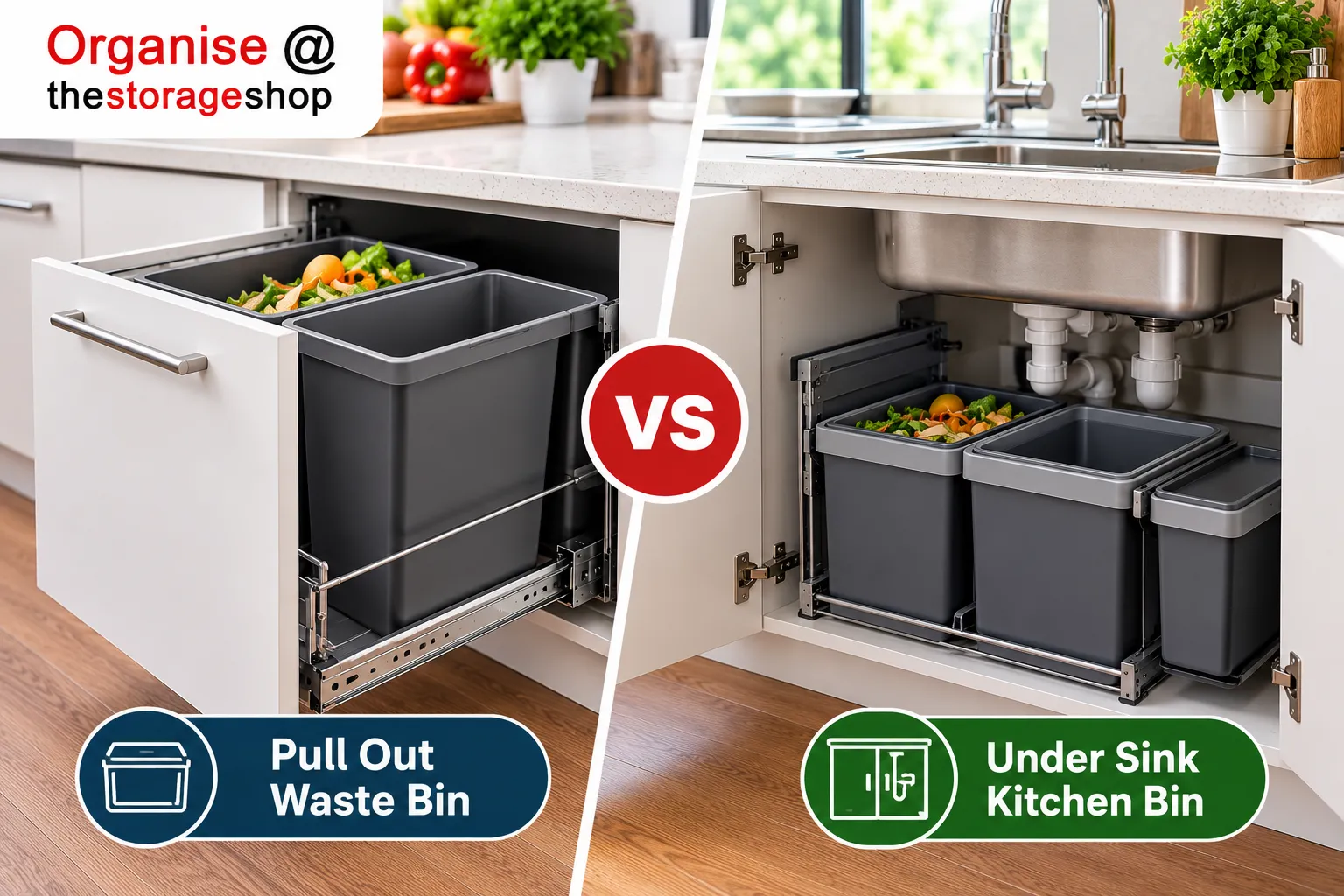

Quick answer: A pull out waste bin and an under sink kitchen bin aren’t really rivals. “Pull out” describes how a bin opens: it slides forward on runners. “Under sink” describes where it lives. Many of the best setups are both, a low pull out bin under the sink. Choose by where your food waste starts and how much room the plumbing leaves.
Watch anyone cook and you’ll see the same loop: peel, chop, turn, walk to the bin, walk back. Put the bin in the wrong spot and that trip happens dozens of times a week.
What’s the difference between a pull out waste bin and an under sink kitchen bin?
A pull out waste bin is defined by its mechanism. Buckets sit in a frame on runners, and you slide them out of a base cupboard to use them. That cupboard can be beside the sink, in an island or anywhere along the bench.
An under sink kitchen bin is defined by its location. It could be a low pull out unit, a small bin that swings out on the door, or a loose caddy sitting on the cupboard floor.
|
Pull out waste bin (own cupboard) |
Under sink kitchen bin |
|
|
Where it goes |
Any base cupboard 300mm or wider |
The sink cupboard only |
|
How it opens |
Slides out on runners |
Slides, swings out with the door, or lifts out |
|
Room for buckets |
Up to four, if the cupboard is wide |
Usually one or two, limited by the pipes |
|
Best for |
Big households and full recycling sorting |
Scraps straight from the sink and chopping board |
|
Watch out for |
Taking a cupboard you’d use for pots |
The S-bend, hoses and isolation valves |
Which is more convenient for everyday use?
Convenience comes down to where the mess is made. If your sink sits next to the main prep bench, an under sink bin is hard to beat. Scraps go from board to bin without a step.
Plenty of kitchens don’t work that way. If you chop on an island or the sink is at the far end of the run, put a pull out bin in the cupboard closest to where you prep. Also check the dishwasher. When its door is down, it can block the cupboard beside it, which gets old fast if that’s your bin.
Space, recycling and capacity
The sink cupboard is shared territory. Pipes, a trap and often a filter or cleaning products all compete for room, so most under sink bins are a single bucket or a low double.
A dedicated base cupboard has no plumbing in the way. A 400–450mm cupboard takes a comfortable double, and a 600mm cupboard fits three or four buckets for general waste, recycling and food scraps.
Look at bucket sizes, not just the total. A 40L double is two 20L buckets, so one 30L bin can actually hold more rubbish if your recycling already lives somewhere else.
Cleaning and smells
Sink cupboards run damp. Tap connections drip and wet sponges get tossed in, so an under sink bin needs a cupboard you check now and then. Whatever style you choose, removable buckets you can rinse in the laundry or outside make the weekly clean far easier than a frame you have to wipe in place.
Choosing kitchen rubbish bins that fit
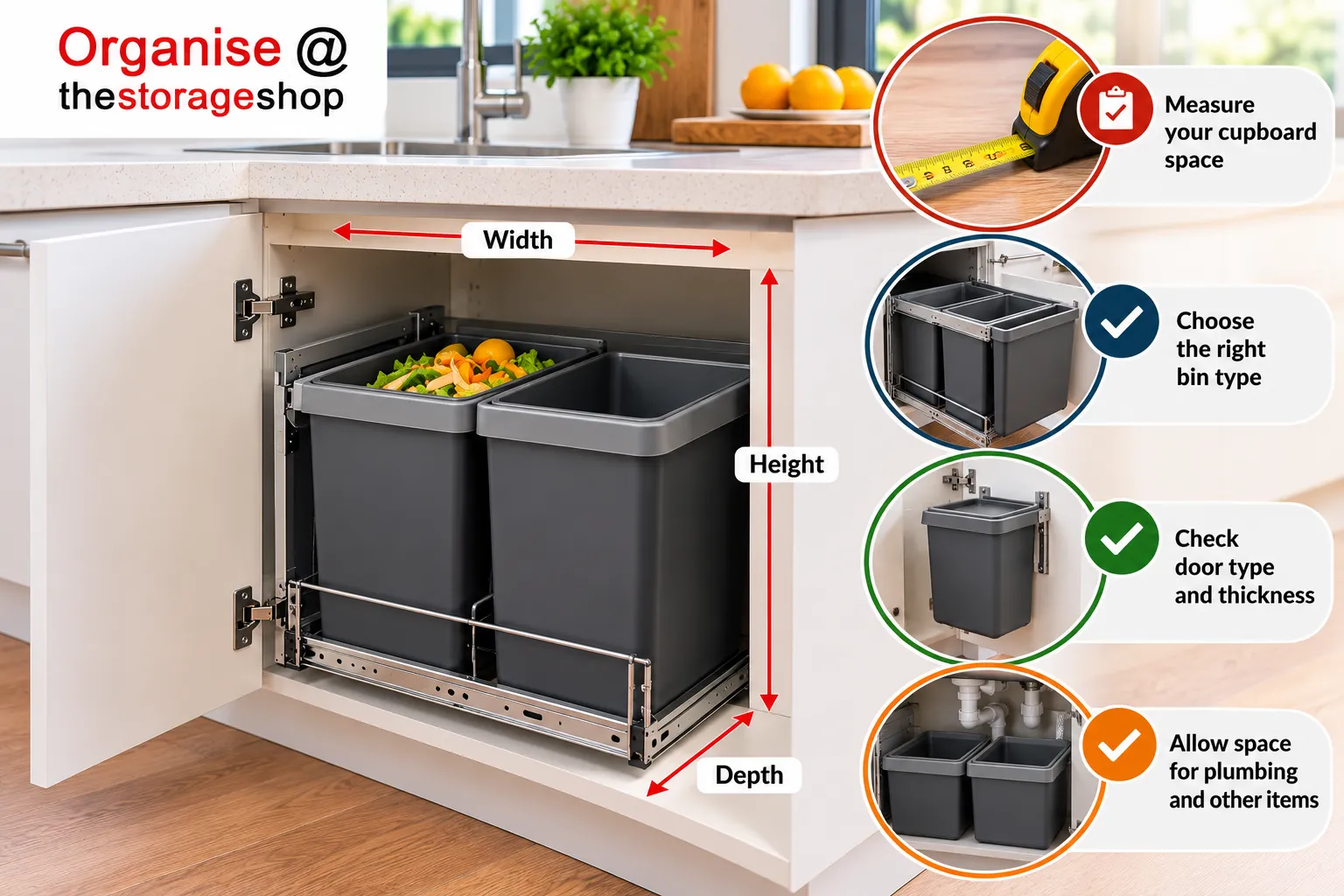
Kitchen rubbish bins come in more mounting styles than most people expect, so measure before you browse. Note the width inside the cupboard, how far back you can go before hitting a pipe, and the clear height under the trap or benchtop. Then check each model’s minimum cupboard size. The Storage Shop’s range covers Kia Ora, Wesco, Hailo and Häfele in several mounting styles, so there’s usually one that fits.
Frequently asked questions
Is a pull-out waste bin better than an under-sink kitchen bin?
Neither is better in every kitchen. A pull-out waste bin in its own cupboard gives you more buckets and easier access. An under-sink kitchen bin keeps scraps close to the sink. If the plumbing leaves enough height, a low pull-out bin under the sink combines both.
Are pull-out kitchen bins hygienic?
Yes, pull-out kitchen bins are as hygienic as you keep them. Lift-out buckets can be rinsed in seconds, and the closed cupboard keeps smells and flies away from the bench. Empty food scraps often, use liners and wipe the frame when something spills.
Can you install a pull-out bin under the kitchen sink?
Yes, as long as the bin’s height clears the S-bend. Low-profile pull-out bins are designed for sink cupboards. Measure the clear height under the trap and the gap between the pipes, then pick a model whose minimum sizes fit inside those numbers.
Which kitchen bin is best for a family?
For most families, a pull-out bin with two or three buckets in a 450–600mm base cupboard works best. It separates rubbish from recycling, holds a few days of waste and keeps everything off the floor. Families with a food organics service should go for three buckets.
How do you stop an under-sink bin from smelling?
Keep food scraps in a lidded caddy or bag and empty them every day or two. Wash the buckets regularly and let them dry before relining. Check the cupboard for drips from tap connections, because damp makes smells worse. A sprinkle of bicarb soda in the bucket also helps.
What size bin fits under a kitchen sink?
Under-sink bins range from about 5 litres for a swing-out scraps bin to around 60 litres for a low double pull-out. What fits depends on the clear height below the trap and the space between the pipes. Measure both before choosing a capacity.
Where should the rubbish bin go in a kitchen?
Put the rubbish bin within a step of where you prepare food, usually beside or under the sink. Avoid the cupboard next to the dishwasher, since an open dishwasher door blocks it. In kitchens with an island, a pull-out bin in the island often works best.
The bottom line
If your sink and prep bench sit side by side, a low under sink kitchen bin covers most households. If you prep elsewhere or sort several waste streams, give a pull out waste bin its own cupboard. Either way, measure inside the cupboard first, and you’ll pick a bin you only think about on bin night.