
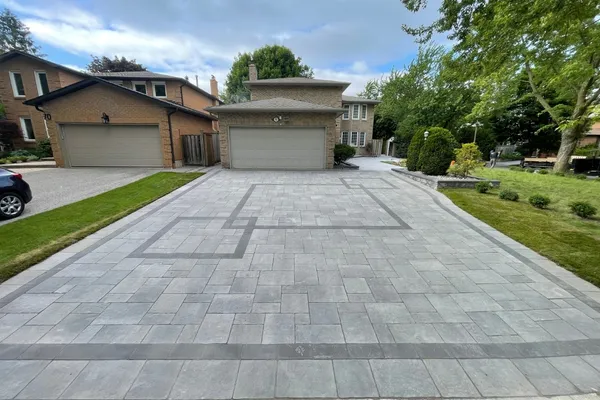
For most GTA homeowners, interlocking is worth the cost if you plan to stay in the home for several years and care about how the driveway looks, performs in winter, and supports resale. Asphalt will almost always win on the first quote, but properly built interlocking usually wins on how long it lasts, how it handles repairs, and how it makes the home feel and show over time.
Below is a practical, contractor-level breakdown based on how driveways actually fail and what makes them last in GTA conditions.
Quick Verdict: When Interlocking Makes Sense
Interlocking is usually the better choice if:
-
You plan to stay in the home at least 7 to 10 years
-
You want strong curb appeal and a finished look
-
You want repairs to be sectional, not a full replacement
-
You care how the driveway handles salt, snow, and freeze-thaw cycles
Asphalt makes more sense if:
-
Budget is tight and you need the lowest upfront cost
-
The property is a short-term hold
-
You are fine with a basic look and future patchwork
Real GTA Pricing Ranges
Exact quotes depend on access, base thickness, excavation needs, and design complexity, but realistic installed ranges many GTA homeowners see are:
Asphalt driveway: Roughly $7 to $12 per sq ft for standard residential driveways
Concrete driveway: Roughly $12 to $20 per sq ft depending on finish (broom, exposed aggregate, etc.)
Interlocking driveway: Roughly $18 to $35+ per sq ft depending on paver choice, base depth, and detailing
These are not the lowest possible prices. They are realistic bands that match what serious contractors charge for proper base work and materials, not shortcuts.
Interlocking vs Asphalt vs Concrete at a Glance
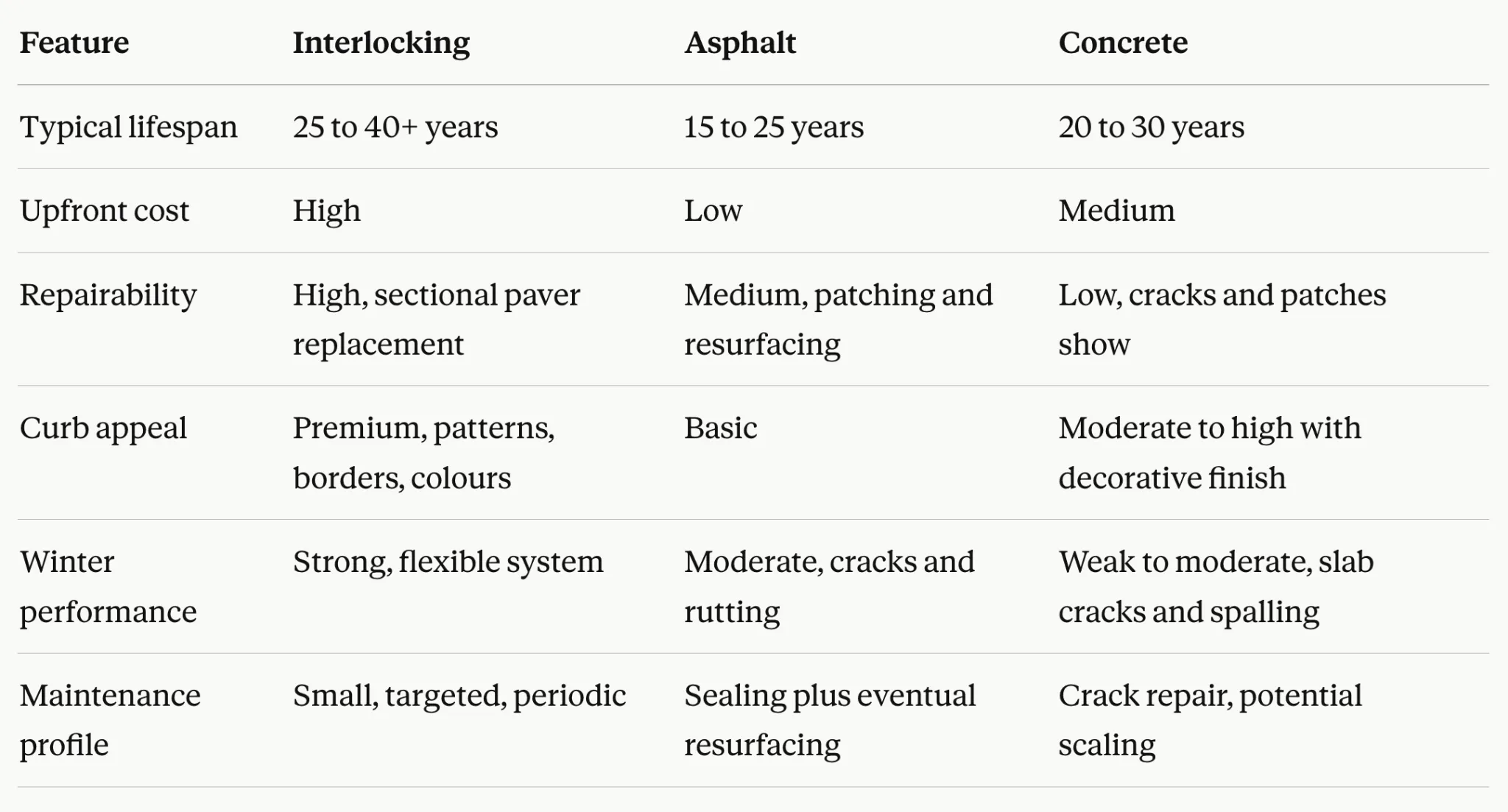
This is why many GTA homeowners start with asphalt but upgrade to interlocking once they have lived through one or two full driveway cycles.
What a Proper Interlocking Base Looks Like in the GTA
This is where real expertise shows. The difference between a driveway that looks good for two years and one that performs for 20 or more starts below the pavers.
For most GTA clay or mixed soils, a contractor-grade interlocking driveway should include:
Excavation depth: Often 12 to 16 inches below finished grade for a driveway, deeper for poor soils, not the 6 to 8 inches many budget quotes allow for.
Base material: Typically well-compacted 3/4 inch crushed stone in multiple lifts, not whatever gravel was cheapest that week.
Base thickness: After compaction, about 8 to 12 inches of base for vehicle loads, depending on soil conditions and expected traffic.
Screed layer: About 1 inch of bedding sand on top of the compacted base. Never more, or you risk tire ruts and settlement.
Slope and drainage: A minimum of about 2% slope, roughly 1/4 inch per foot, away from the house so meltwater does not sit against foundations or garage doors.
Edge restraint: Proper concrete or engineered edge restraints to keep pavers locked under vehicle load, not just burying the edge and hoping for the best.
One of the most common failures seen in GTA driveways is settling right at the garage entrance. Installers cut the base depth short at the threshold to save excavation time. The tires hit that transition point every single day, and with only 4 to 6 inches of base there, it slowly deforms and drops. A homeowner sees this as sinking pavers when the real problem is an underbuilt base.
Why Some Interlocking Driveways Fail After 2 Winters
Interlocking does not automatically mean high quality. When the base or details are wrong, it can fail faster than asphalt. Typical failure patterns include:
Base too shallow or poorly compacted: The driveway looks fine the first season but develops dips and waves once the base pumps and settles under repeated freeze-thaw cycles and vehicle traffic.
No proper drainage plan: Water runs toward the house or sits in flat areas, saturating the base and accelerating frost heave.
Excess bedding sand: More than about 1 inch of sand becomes a sponge under tires. Pavers rock, joints open, and patterns spread.
Cheap polymeric sand or no joint stabilization: Joints wash out, weeds take over, and pavers loosen. Many poly sand failures come down to cheap products or rushed installation where joints were not fully packed, pavers were not dry, or joints were not properly compacted.
A properly built driveway addresses all of these up front. That is why serious interlocking quotes are higher. They are pricing enough base, compaction time, and drainage correction to avoid rebuilding the job a few years later.
Real-World Ownership: How Costs Show Up Over Time
Think in 10 to 20 year windows, not 1 to 2.
Asphalt ownership profile:
-
Lower upfront cost
-
Needs sealing every few years
-
Cracks develop and spread
-
Patches and resurfacing change the appearance over time
-
Eventually the whole surface needs replacement
Interlocking ownership profile:
-
Higher upfront cost
-
Joints may need re-sanding and occasional cleaning
-
Localized settling or damage can often be fixed in sections
-
Appearance can be refreshed without starting from zero
-
Base and pavers can keep performing long after a basic asphalt driveway would be replaced
The big difference from an owner’s perspective is that problems with interlocking are often isolated and fixable instead of requiring a full redo.
How Interlocking Behaves in GTA Winters
GTA winters are tough on driveways: freeze-thaw cycles, plows, snow blowers, salt and de-icing chemicals, and water that refreezes in cracks.
A rigid slab, whether asphalt or concrete, tries to resist movement. Once it loses that fight, it cracks. Interlocking accepts small movements instead:
-
Joints allow minor shifts without visible structural damage
-
Pavers can be re-leveled if one area heaves
-
Damage from salt is usually limited to the surface of individual stones, not an entire slab
This is why many homeowners who have lived through a couple of driveway replacements move to interlocking. It is simply a better match for how GTA winters actually behave.
Curb Appeal and Resale: More Than Just Looking Nice
Curb appeal affects how buyers value and remember a home. Exterior condition and landscaping are consistently noted as major factors in buyer interest and perceived property value.
In practice, interlocking helps resale because:
-
It photographs better in listings than cracked asphalt or stained slabs
-
It visually ties into other hardscape elements like walkways, steps, and patios
-
It signals that the homeowner has invested in the property rather than just getting by
A buyer may not assign an exact dollar figure to an interlocking driveway, but they will compare your home against the one down the street with a patchy, failing surface. That comparison usually favors the property with quality hardscaping.
Why GTA Homeowners Often Upgrade Driveways and Patios Together
Many homeowners eventually decide to tie the property together from front to back using the same or complementary pavers on the driveway, front walk, porch, and backyard patio. The result is a continuous hardscape that feels designed rather than pieced together.
Upgrading the driveway and patio within a similar timeframe:
-
Reduces total disruption by combining into one major project
-
Allows better drainage planning across the whole lot
-
Creates a cohesive, high-end look that supports both daily enjoyment and resale
FAQs
Is an interlocking driveway really worth it? Yes, if you plan to stay in the home for several years and care about curb appeal and long-term performance. Expect to pay more upfront than asphalt but gain a longer service life, better repair options, and a driveway that continues to present well over time.
How long does an interlocking driveway last? With proper base preparation, materials, and maintenance, many interlocking driveways in GTA conditions perform well for 25 to 40 or more years. Poor base work, however, can cause failure in just a few winters.
Why do some interlocking driveways sink or shift? Most sinking and shifting comes from an underbuilt or poorly compacted base, not the pavers themselves. Shortcuts like shallow excavation, wrong aggregate, or insufficient compaction show up a few years later as dips, waves, or settlement, especially near high-load areas like garage entrances.
Is interlocking more expensive than asphalt? Yes. Interlocking typically costs roughly $18 to $35+ per sq ft installed, versus roughly $7 to $12 per sq ft for asphalt, depending on site conditions and design. Over time, interlocking often reduces large repair and replacement cycles, which can improve overall ROI.
Can interlocking handle GTA winters? When built on a proper base with correct drainage and quality materials, interlocking handles GTA freeze-thaw cycles very well. Small movements can be corrected by re-leveling sections rather than replacing an entire slab.
Bottom Line: Who Should Choose Interlocking?
Interlocking is a smart choice if you want a driveway that still looks good in 10 or more years, care about how your home presents from the street, prefer targeted and fixable repairs over full replacements, and are thinking about the property as a long-term investment rather than a short-term fix.
If you just need the cheapest functional surface for a short period, asphalt is fine. If you want your driveway to work as part of a lasting, high-quality exterior that supports both daily life and future resale, interlocking is usually worth the higher upfront cost.
For GTA homeowners who want a realistic design, honest base recommendations, and a clear breakdown of what their project will actually take, explore our Driveway Interlocking or Patio Interlocking services and see what a properly built interlocking driveway would look like for your home.